The short version
in four steps- Photograph each card in daylight, flat on a plain, uncluttered surface. Capture both sides of the card from straight above, no flash.
- Type it up exactly as written, quirks and all. Put your updates (real measurements, oven temps) underneath.
- Keep the photo with the typed recipe, always. The handwriting is half the reason you’re doing this.
- Store the originals flat and dry, in acid-free sleeves. No tape, no laminating.
Every family has one. A tin box on top of the fridge. A binder that’s barely holding together. An envelope that just says “recipes.” Nobody’s opened it in years, and nobody would dream of throwing it out.
But there’s only one of each card. One spilled coffee, one house move, one relative on a decluttering kick, and it’s gone for good, handwriting and all.
Digitizing them isn’t really about scanning. It’s about keeping the person who wrote them: the way they looped their g’s, the “add more flour” squeezed into the margin, the stains from twenty years of Christmas baking. The recipe is the easy part.
How to scan old recipe cards with your phone
You don’t need a scanner. Your phone and a bright window will do. Put the card on a plain table and hold your phone directly above it, so it doesn’t come out lopsided. Leave the flash off. It washes out pencil and makes grease spots glare.
Fill the frame and capture both sides of the card, so you get all the little details. The back is where the good notes live: “double for Christmas,” “Ed hates walnuts.” Ed’s feelings about walnuts are now part of the family record.
Want to skip the typing too? Snap the card in Plated Pages and it reads the handwriting for you, scribbles in the margin included, and types up the whole recipe. More on that below.
Never clean a stain to get a better shot. Leave it exactly as it is. :)
More detail: when the pencil has faded
Take the photo first and fix the photo afterward. In your phone’s photo editor, turn the contrast up and the brightness down a little. Faded pencil often comes right back.
Type up the recipe, and keep the handwriting
A photo of a card is lovely, but you can’t search it, double it for a crowd or read it from across the kitchen. So type up the ingredients and the steps, set out the same way for every card, and you’ll always know where to look.
Type it the way they wrote it. If the card says “a pinch of this” or “bake till golden,” that’s what goes in, because their words are part of the recipe. Then, on a line underneath, add what you’ve worked out: real measurements, an oven temperature, anything you had to figure out at the stove. That way you keep their version and get one you can actually cook from.
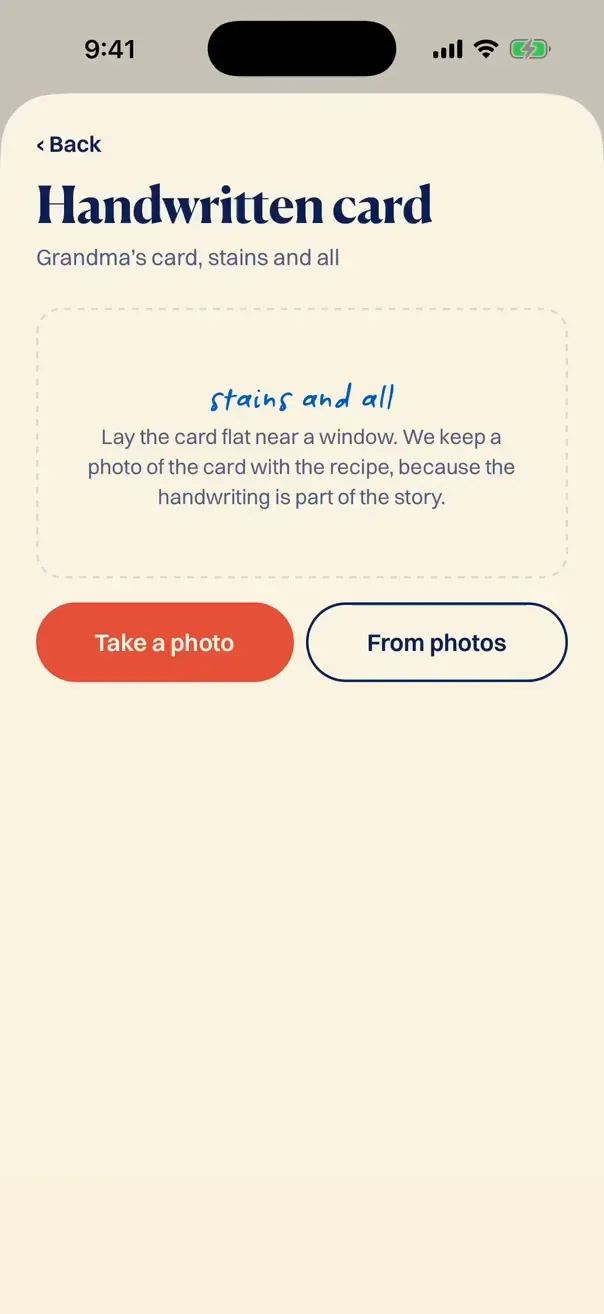
In Plated Pages, you can add a recipe straight from a handwritten card. Snap it and every word gets typed out for you. The card itself stays with the recipe, front and back, so their handwriting is right there every time you make it.
Our rule: the more stained the card, the better the recipe. Nobody splatters butter on something they only made once.
What old recipe abbreviations mean
Old cards use words and shortcuts nobody uses anymore. Here’s what the most common ones mean, so you know what to type.
Can’t make out an amount? Take your best guess and make it once. If it turns out right, that’s your number, so write it down. If not, adjust and try again. Worst case, you eat a slightly odd cake while you figure it out.
Fill in the missing measurements
Old cards skip things because whoever wrote them didn’t need them. Aunt Sandra made that casserole every Sunday for forty years. She knew what “bake until done” meant. She knew exactly whose hand “a handful of oats” was. The rest of us are just trying to get dinner on the table, and we’d like a number.
If the person who wrote it still makes it, cook it with them once. Each time they reach for a handful or a splash, have them put it in a measuring cup first, so you can write down the real amount. They may roll their eyes. Measure anyway.
Actual instructions from an actual card. Aunt Sandra stands by them.
While you’re at it, record them telling it. Years from now, their voice saying “no, not like that” will be your favorite part.
More detail: questions worth asking
- Where did you learn this?
- What did you change from the original?
- How do you know when it’s done?
- What’s the part everyone gets wrong?
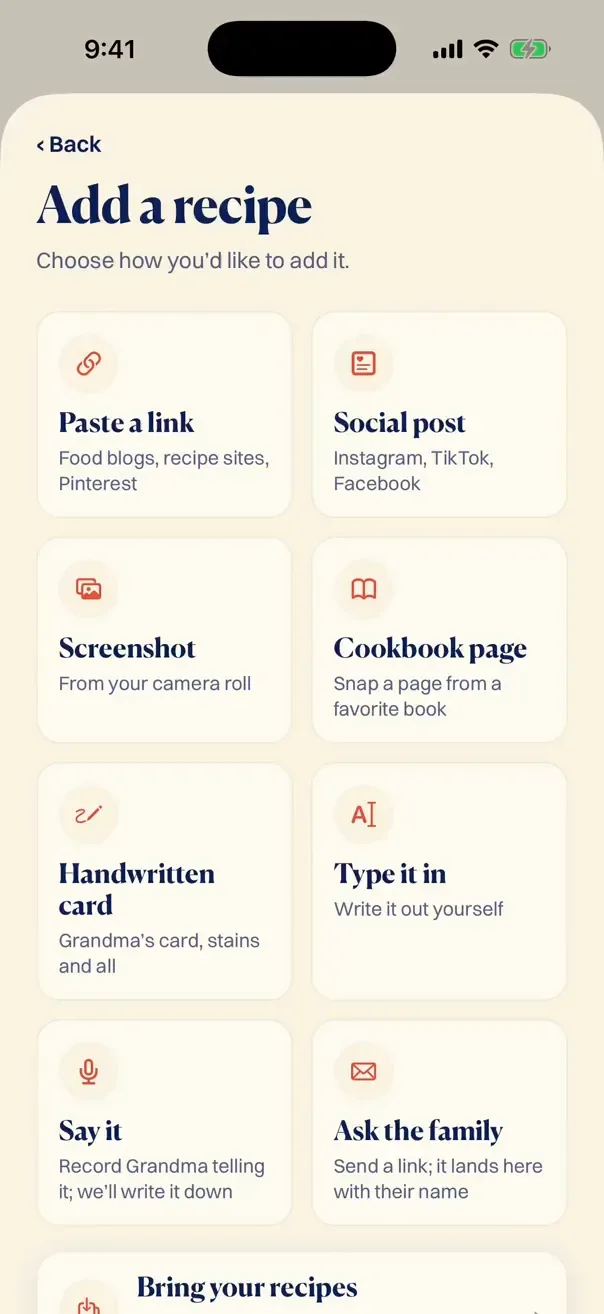
With “Say it,” they talk you through the recipe their way and Plated Pages writes it down. Or use “Ask the family” to send them a link, and whatever they add comes back with their name on it.
How to store old recipe cards so they last
The digital copy is your backup. The cards are still the real thing, so give them a better home than the top of the fridge.
- Store them flat, in acid-free sleeves, folders or a box.
- Keep them somewhere cool, dry and dark, like a closet shelf or a drawer. Attics get too hot, basements get damp, and above the stove gets steamy.
- No tape, glue, rubber bands or paper clips. Skip laminating too. It can’t be undone.
Keep the digital copies in two places, like your phone and a folder the whole family can open. That way a lost phone is just a lost phone.
Later, turn them into a family cookbook
Once every recipe is saved, a printed family cookbook is a lovely next step: something to hand down that never needs charging.
Plated Pages will print family cookbooks too, a little later on. For now, get every card photographed, typed up and safe.
Questions people ask
What’s the best way to scan old recipe cards?
You don’t need a scanner, just your phone. Put the card on a plain table near a bright window, hold your phone directly above it, fill the frame and leave the flash off. Capture both sides of the card so you don’t miss any of the little details. Many notes and cloud-storage apps have a document-scan mode that straightens the edges for you.
Should I keep the original cards after scanning them?
Yes. A scan is a backup, not a replacement. Store the cards flat in acid-free sleeves or a box, somewhere cool and dry, out of the light. Skip tape, glue and laminating. They’re hard or impossible to undo.
How do I read faded handwriting?
Photograph the card in daylight, then zoom in and turn the contrast up and the brightness down a little in your phone’s photo editor. Ask someone who knows the writer’s handwriting. Or snap it in Plated Pages, which reads the handwriting for you and keeps the photo, so you can check any word against the card. Still unsure? Make your best guess, cook it once, and write down what worked.
Is there an app that reads handwritten recipe cards?
Yes. In Plated Pages, choose Handwritten card and take a photo of the front and back. It reads the handwriting, even the notes squeezed into the margins, and types up the ingredients and steps for you. The photo stays with the recipe, so you can check any word against the original card.
What does “moderate oven” mean in an old recipe?
Roughly 350 to 375°F (175 to 190°C). A slow oven is about 300 to 325°F (150 to 165°C) and a hot oven about 400 to 450°F (200 to 230°C). Old recipes were vague about this, so start in the middle of the range and keep an eye on it.
Sources we checked: storage advice from the Library of Congress, caring for paper and Bridgewater College Special Collections on lamination. Oven terms vary by source; ours follow the common ranges collected on Wikipedia’s oven temperatures page.