The short version
four simple steps- Cook it with them once. It’s the only way to see what “a little” means.
- Measure every handful before it hits the bowl. Whatever they’d pour straight in goes into a measuring cup first, so you get the real amount.
- Write it twice: the way they say it, and the real amounts you measured. Keep both.
- Record them telling it. Half the recipe is in how they say it.
Every family has one recipe without measurements, and it’s usually the best one. Try asking for it.
The person who makes it has made it a thousand times, and the recipe lives in their heart, not on paper.
You can’t get it from a card, because there isn’t one. You can’t get it over the phone, because “until it feels right” means nothing until you’ve seen it with your own eyes. So here’s how to write down a recipe without measurements: cook it with them once, and measure every handful on its way into the bowl.
Ask for a lesson, not a recipe
Ask for the recipe and you’ll get “oh, I just throw it together.” Ask them to show you how, and you’ll get every step, every pinch, and the stories in between. So set a day, go to their kitchen, and let them make it the way they always do, with their pots and their ingredients. You’re not there to change anything, just to write it down.
All you need is a measuring cup, a set of measuring spoons, a notebook and your phone. Most kitchens have the cups in a drawer somewhere; if theirs doesn’t, bring a set. Put them right next to the bowl, where their hands already are.
Every family recipe, same answer.
Measure every handful before it hits the bowl
Each time they reach for a handful of rice or a splash of oil, ask them to put it in the measuring cup first, then tip it into the bowl. Say it back out loud, “so that’s about half a cup,” and write it down before the next ingredient. They may roll their eyes. Measure anyway.
If there’s a kitchen scale in the house, it’s faster for flour, sugar and anything that comes by the handful. Set the bowl on the scale, zero it before each ingredient (that’s the tare button), let them add, and write the number. The scale doesn’t argue.
Watch what they measure with, too. Their “cup” might be a teacup, a coffee mug or the one glass they’ve always used.
How much is a pinch, a dash or a handful in cups?
Sometimes an ingredient goes in before you can measure it. Here’s roughly what the usual words work out to. A pinch from their hand is bigger or smaller than one from yours, so when you can, measure the pinch they actually use.
Write down what they look for, not just what they do
“Cook until done” means something to them. Ask what they’re looking for: the color, the smell, the sound, the time on the clock. “Fry the onions until they turn see-through, about eight minutes” is a recipe. “Fry the onions” is a suggestion.
Note the pan, the heat and the oven setting. Start a timer when the pot comes to a simmer and write down the time when they turn the heat off. Nobody says those numbers out loud, and they’re the ones you’ll be guessing at when you cook it alone.
More detail: questions worth asking while it cooks
- What do you look for before you take it out?
- What goes wrong when other people make it?
- What did you change from the way you were taught it?
- Which part can’t be rushed?
Keep the way they say it
Write the recipe twice on one page: the way they say it, and what it measured out to. The measurements let anyone cook it. Their words make it theirs.
As they say it, and measured
Their version is the recipe. Yours is just the translation.
If they always cook with the same mug, fill it the way they do with flour, tip that into a dry measuring cup, and write it down. Do it once more with water for liquids. Now you know what “a mug” means in every recipe they make.
Record the family recipe as they tell it
Before you start, open “Say it” in Plated Pages, put the phone down near the counter, and let them talk through the recipe while they cook: the story about the year it went wrong, the “no, not like that” when you stir too fast. Noisy kitchen? Have them tell it once more while it bakes. By the end you have the amounts in your notebook and their voice telling the whole thing on your phone.
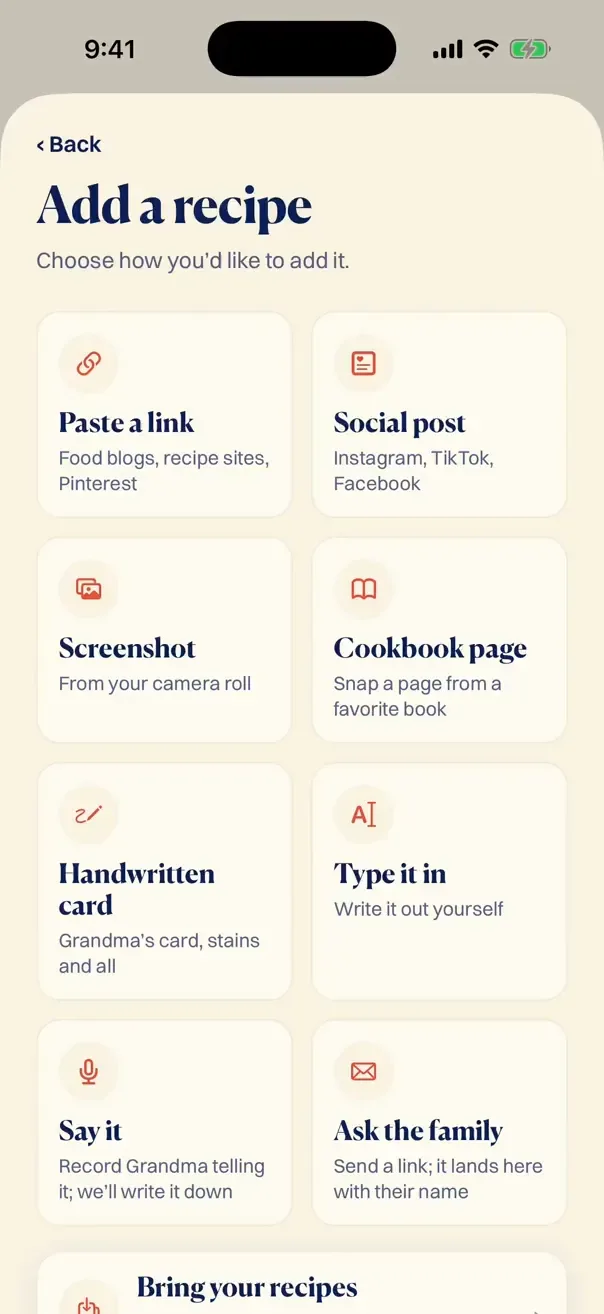
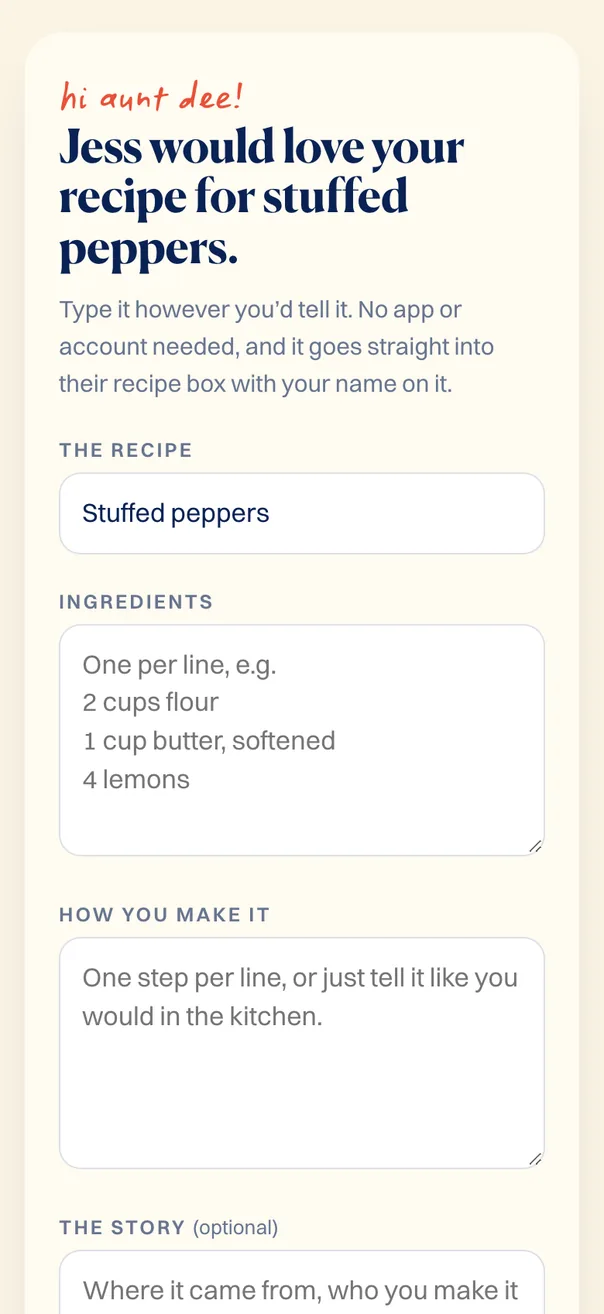
This is the Add a recipe screen in Plated Pages. Tap “Say it” and let them tell it their way. Plated Pages writes it down as a recipe you can cook from, and the recording stays with it. “Handwritten card” is for the recipes that made it onto paper, and “Ask the family” is for the relatives who live too far away to cook with.
Then cook it on your own that same week, from your notes alone. Whatever you have to guess is the question to ask next time. Two tries and it’s yours for good.
Pass it on to the cousins
Once it’s written down, it can go to the cousins, the kids, the one sibling who always asks. Put the name of the person who taught you on it, right at the top: “Aunt Dee’s stuffed peppers.” That’s the first thing anyone in the family looks for.
In Plated Pages, “Ask the family” sends a link, and recipes land in your collection with the sender’s name on them. Once the family’s recipes are all in one place, a printed cookbook is the natural next step. Plated Pages cookbooks are coming soon.
 Share a recipe with me?platedpages.com
give me a minute honey
Questions people ask
How do I write down grandma’s recipe without measurements?
Cook it with the person who makes it. Put a measuring cup under their hand each time they add something, write the amount, and ask what they look for at each step: the color, the smell, the time. Write it the way they say it, with the real amounts underneath, so you keep both. Record the whole thing while you’re at it: “Say it” in Plated Pages writes the recipe down as they talk. And for the recipes that did make it onto a card, our guide to digitizing handwritten recipe cards picks up from there.
How much is a pinch, a dash or a handful?
Roughly: a pinch is about 1/16 of a teaspoon, a dash about 1/8 of a teaspoon, and a handful somewhere around half a cup. But their pinch isn’t your pinch. If you can, measure the one that actually goes into the dish, and if you only have the grams, Sous in Plated Pages can turn them into cups.
Should I use measuring cups or a kitchen scale?
A scale, if you have one. Set the bowl on it, zero it before each ingredient, let them add, and write the number. It’s faster than cups and nobody has to change how they cook. Write the cup equivalent next to it later, when you cook it yourself, or ask Sous, the kitchen helper in Plated Pages, to turn the grams into cups.
What if they won’t measure anything?
Don’t make them. Weigh the flour bag before you start and again when they’re done, and the difference is how much went in. Fill the mug they always use with water and pour it into a measuring cup once. Hold a measuring cup under the handful on its way to the bowl. And record them anyway: “Say it” in Plated Pages writes down what they say, “a couple handfuls of rice” included.
Is there an app that writes a recipe down while someone tells it?
Yes. In Plated Pages, tap “Say it,” press record, and let them tell it their way, “a little of this, a pinch of that.” Plated Pages writes the recipe down, and their voice stays saved with it.
How do I record a family recipe if we live far apart?
Cook it together on a video call. Ask them to keep a measuring cup next to the bowl and hold each amount up to the camera before it goes in. Or in Plated Pages, send them an “Ask the family” link, and whatever they add lands in your collection with their name on it.
Sources we checked: Cardamom and Tea’s “Recording Your Family Recipes” (the weigh-as-they-cook method), SBS Food’s “The Art of Recording a Family Recipe” (the questions to ask), and Wikipedia’s page on approximate measures, which notes that sources disagree.